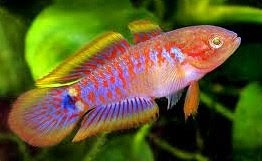
TATEURNDINA OCELLICAUDA
The extremely friendly nature is an ideal ward for small to medium sized aquariums from 60 cm length. A socialization with other fish is possible. At the water values, no special demands are made, medium to hard water with a pH around the neutral point is well accepted and extends itself for breeding this interesting Pfleglinge. A distinction between the sexes is relatively easy using the much larger and more magnificent head coloration of males. For breeding you should put the animals in a separate pool. As a "spawning substrate" have proven PVC tubes; they are usually immediately accepted as nests. The nest is guarded until they hatch the young fish by the male. As the boys from the start feeding on Artemia, the growing of this aquarium fish is very simple and recommended....
TAIL FLECK SCHLÄFERGRUNDEL
The extremely friendly nature is an ideal ward for small to medium sized aquariums from 60 cm length. A socialization with other fish is possible. At the water values, no special demands are made, medium to hard water with a pH around the neutral point is well accepted and extends itself for breeding this interesting Pfleglinge. A distinction between the sexes is relatively easy using the much larger and more magnificent head coloration of males. For breeding you should put the animals in a separate pool. As a "spawning substrate" have proven PVC tubes; they are usually immediately accepted as nests. The nest is guarded until they hatch the young fish by the male. As the boys from the start feeding on Artemia, the growing of this aquarium fish is very simple and recommended....
Brachygobius SABANUS
Unfortunately, there is no detailed to this species. Us is but anxious that the animals are kept humanely. So if you are unsure whether these animals fit into your existing system or need information about the other Hälterungsbedingungen we ask them before placing your order absolutely to contact our service team. We are happy to help. Thank you
Anomalochromis thomasi
Name: anomalochromis thomasi
Scientific. Name: Anomalochromis thomasi
Origin: Africa: Guinea, Sierra Leone, Liberia
Current Size: 4-6 cm
Finished size: 8-10 cm
Beck Length: 60 cm
pH: 6.5 to 6.8
Water Hardness: 7-12 ° dGH / 3-6 ° dKH
Temperature: 23 - 28 ° C
Diet: it assumes each feed
Description:
This type is the older aquarists still known under the (false) generic 'Pelmatochromis ". A. Thomasi is one of the most best-kept dwarf cichlids in community aquariums. In their natural range in Sierra Leone they settled almost all available water types. Meanwhile, a number of differently colored local forms are known, some of which have a bright red lined row of dots on the gill cover. Since it is a peaceful cichlid with this type, you can socialize with them almost all the fish, provided they are not too aggressive. For the care and breeding aquariums are located from 80 cm length, which are fitted with dark ground and a dense edge planting. Due to the large natural adaptability to different water compositions, the water values play in the aquarium only a subordinate role, if they do not move in extremes. All major types of food are accepted without any problems, the addition of feeding live food supports the coloration of the species. The breeding of monogamous open breeder takes place either in the community tank or, at harmonizing pairs, in a separate breeding tank, which needs only 60 cm tall. As spawning substrate usually used a flat stone, which is dressed up vigorously by two animals. The nest, which can contain up to 200 eggs will alternately looked after, and it is advisable to use some peaceful alien fish to support the parental care instinct. After hatching, the larvae after 48 hours they will be reburied in a pit, after a week the breeding floats free and can be fed with Artemia under the leadership of the parent animals.
LIFALILIS cichlid
LIFALILIS cichlid
The natural circulation area of this colorful cichlid is located in the West African catchment area of Zaire River. There he settled oxygen-rich streams of the jungle. The species is very similar Hemichromis bimaculatus, but is not so big and is not as aggressive as this by far.
To take care of this kind rich aquariums of 80 cm length, etc. with a dark ground, many hiding by wood should be and decorated with a bold border planting. Water values play only a subordinate role. A socialization with other fish is possible because the kind defended aggressively only at the time of brood care their territory.
The breed can be done in the community aquarium, as well as open guard breeder Parents her brood. Even in medium-hard with a pH is set to hard water above pH 7 a breeding success. From the up to 300 eggs, which are usually stored on a flat stone or in a pre-dug pit, slip at 27 ° C after about three days the larvae that are reburied in disturbances in other mines. After one week the young fish swim freely and can be fed with Artemia.
Purple splendor cichlid
P. pulcher is a well-known representatives in our aquariums, but most Cichlidenfreunde have made first breeding experience of this type. Most of the older aquarists will be known under her (false) name "Pelmatochromis kribensis" the kind. The natural circulation area of Königscichliden are the streams and tributaries in southern Nigeria, where he found himself in brackish water regions. Even in the western part of Cameroon, in the territory in Ndonga, this well-kept like cichlid has its dissemination. Meanwhile, a number of differently colored local forms are known. A well planted, with wood and hiding places (default: hollowed coconuts) set up aquarium can be described as ideal. At the water values are hardly made claims since he must adjust to changing values in nature. Medium-hard and hard water with a pH above the neutral point are also accepted as soft and slightly acidic water. Thus, a whole range of styles offer with which the presented species can be socialized. The feeding does not bring problems: They will eat just about anything, which naturally varied live food is clearly preferable and is best suited for the development of the animals. One of socialization with other fish is no obstacle, because it bothered other fish only during the spawning period and in guiding the young fish. Spawning is initiated by digging spawning caves beneath stones and roots or small pits, the young fish are reburied in later. The nest, which may include 150-200 eggs will be deposited in a cave and at first only looked after by the female while the male takes care of the backup of Ablaichreviers. When leaving the protective cave after about a week of juvenile fish swarm, he is cared for by both parents. The juveniles can be immediately fed with Artemia.
EMERALD PRACHT BASS
EMERALD PRACHT BASS
This attractive Zwergcichlide has - in various local color forms - his home in forest streams and rivers of Nigeria and Cameroon, where the form shown here comes from western Cameroon in the area around the village Moliwe. The streams of this region lead soft water with a pH close to neutral (pH 7). In the aquarium, you should take this into consideration. The device bearing plants, many hiding places and caves that can be built with wood and stone, is necessary for a permanent care. The substrate should best consist of fine sand. When food is accepted even after settling flake food, better, but it is varied to feed with Frost and mainly live food. Like the other P. taeniatus color forms part of this form to the cavity-nesting birds, which initially assume the females the brunt of parental care, while the males take care of the security of territorial boundaries. After the free-swimming the boys also the male involved more actively in the care. The nutrition and rearing designed at optimal water care and feeding of fine live food as easily.
LIFALILIS cichlid
LIFALILIS cichlid
Das natürliche Verbreitungsgebiet dieses farbenprächtigen Buntbarsches liegt im westafrikanischen Einzugsgebiet des Zaire River. Dort besiedelt er sauerstoffreiche Bäche des Urwalds. Die Art ähnelt sehr stark Hemichromis bimaculatus, wird aber nicht so groß und ist bei weitem nicht so aggressiv wie diese. Zur Pflege dieser Art reichen Aquarien von 80 cm Länge, die mit dunklem Bodengrund, vielen Verstecken durch Holz u.ä. und mit einer kräftigen Randbepflanzung dekoriert werden sollten. Wasserwerte spielen nur eine untergeordnete Rolle. Eine Vergesellschaftung mit anderen Fischen ist möglich, da die Art nur zur Zeit der Brutpflege ihr Revier aggressiv verteidigt. Die Zucht kann im Gesellschaftsaquarium erfolgen, da die Offenbrüter als Elternfamilie ihre Brut gut bewachen. Selbst in mittelhartem bis hartem Wasser mit einem pH-Wert über pH 7 stellen sich Zuchterfolge ein. Aus den bis zu 300 Eiern, die meist auf einem Flachen Stein oder in einer vorher ausgehobenen Grube abgelegt werden, schlüpfen bei 27° C nach etwa drei Tagen die Larven, die bei Störungen in andere Gruben umgebettet werden. Nach einer Woche schwimmen die Jungfische frei und können mit Artemia ernährt werden.
Schwefelkopf mouthbrooders
Otopharynx lithobates is the most famous representative of this genre, considering that most aquarists know this kind under various generic names as Haplochromis, Aulonocara, Cyrtocara, Trematocranus or Aristochromis with the dealer name "lombardoi". Otopharynx lithobates inhabited the southern part of Lake Malawi, where he - like Aulonocara species - preferably staying in caves. In addition to the color variant shown here another variation exists with a striking yellow forehead. The females, however, are silvery with three dark spots on the sides. Since adult males usually not much greater than 12 15 cm - are, they are for aquariums from 100 cm thoroughly recommended. In addition to the natural habitat adapted Beck means is to pay attention to a balanced diet with plenty of plant foods. The breeding of this cichlid is not too difficult. After a small pit was dug by the male, spawning takes place in the typical for most mouthbrooders T-position. After 14-18 days between 20 and 40 juveniles are released by the female from the mouth. Feeding the breeding can be done immediately with Artemia.
STEEL BLUE mouthbrooders
Zu dieser Tierart liegt leider noch keine Detailbeschreibung vor. Uns liegt aber viel daran das die Tiere artgerecht gehalten werden. Wenn sie also unsicher sind ob diese Tiere in Ihre bestehende Anlage passen oder Informationen zu den weiteren Hälterungsbedingungen benötigen bitten wir sie vor Ihrer Bestellung unbedingt unser Service Team zu kontaktieren. Wir beraten sie gerne. Vielen Dank
YELLOW-BLUE IMPERIAL cichlid
A. hansbaenschi bewohnt die Sand-Fels-Übergangszone an der Malawi-Ostküste im Bereich von Makanjila/Fort Maguire. Im Handel wurde diese Art als A. "Red Flush" oder auch A. "Red Flash" bezeichnet. Der erste, bereits 1972 eingeführte Kaiserbuntbarsch, der damals fälschlicherweise als A. nyassae angesprochen wurde, könnte artgleich mit A. hansbaenschi sein. Die damals gefangenen Exemplare stammten von der mossambikanischen Ostküste des Malawisees und wurden später auch A. "Rotschulter" genannt, als klar wurde, dass A. nyassae eine ganz andere Art darstellt. Im Süden des Sees lebt eine weitere Population bei der Insel Thumbi West, die ebenfalls zu A. hansbaenschi gehören dürfte. Dieser Cichlide fällt durch seine geringe Größe und die nur schwach ausgeprägte Rotfärbung im Schulter- und Brustbereich auf. Die Handelsbezeichnung für diese Population ist A. "Cobue". Zur erfolgreichen Haltung im Aquarium genügen Becken ab 100 cm Länge, die mit hellem Bodengrund und Steinaufbauten eingerichtet sind. Pflanzen werden nicht behelligt. Der gegenüber anderen Fischen sehr friedliche Buntbarsch kann problemlos auch mit Nicht-Cichliden vergesellschaftet werden. Aggressive oder hektische Mitbewohner sind nicht zu empfehlen, da der Kaiserbuntbarsch sonst sehr scheu werden kann. Da es sich bei den Aulonocara-Arten um agame Maulbrüter handelt, sollten zur Zucht immer ein Männchen mit mehreren Weibchen zusammengesetzt werden. Da sich die Weibchen der Aulonocara-Arten voneinander kaum unterscheiden, ist darauf zu achten, dass keine Arten gemischt werden, da sonst Bastardierungen entstehen können. Die Jungfische werden nur vom Weibchen betreut und verlassen nach ca. drei Wochen das Mau
Melanochromis auratus
The natural range of this cichlid is in the southern part of Lake Malawi, although he does not appear in all sorts of habitats. Thus one finds larger populations in the islands and Maleri Mbenji. This very striking colored cichlid belongs to the group of "Mbuna", the Felsencichliden, like the Tropheus species of Lake Tanganyika, are similarly closely bound to the rocky shore zone and the end on the rocks nursery, the main food source of this cichlids. The significant Geschlechtsdichromatismus (= different color between the sexes) allows for a simple distinction between the sexes. The attitude of the area forming, agamids mouthbrooders should only be done in aquariums from 100 cm length. Best kept Melanochromis in society with other Mbunas. As in their natural habitat, the number of individuals is very high, and a high number of different Felsencichliden the aquarium has a clear aggression inhibitory effect on the individual animal. The breeding is mostly done in a community tank, where the female takes 20-30 eggs in her mouth and dismisses as colored 1 cm large juveniles after about three to four weeks.
MARMALADE CAT
MARMALADE CAT
Family: cichlids (tilapia)
Subspecies: There are known about 23 different subspecies of Emperor cichlids (Aulonocara)
Size: Depending on the subspecies Aulonocara can reach a final height of about 9 to 18 cm
Features: Peacocks (Aulonocara) show up in typical manner perch with a muscular-looking body and the typical spitzmäuligen head.
Lining: frozen food and flakes are gladly accepted
Social behavior: The Kaiserbuntbarsch- (Aulonocara-) types are all very peaceful contemporaries who do not appreciate it, to be associated with aggressive or even predatory fish species!
Fish breeding: Peacocks (Aulonocara) are together mouthbrooders who most enjoy watching seem to proliferate in rock or Sandlitoralen itself. The males form there areas. In the districts, a cavity is preferred. The young hatch from the yolk-rich eggs after 17-19 days at a water temperature of 28-29 ° C. CAUTION: Stud wishes only one type Aulonocara (Kaiser cichlid) should be maintained, because the species might otherwise intercross!
Origin: Malawi (East Africa)
Attitude: The Emperor smaller cichlids (Aulonocara) can be kept in a tank of 200 liters capacity. The ground of the basin should be made of sand. Good are some caves as a retreat or for the districts. It is suitable for aquarium maintenance best combination of a male with several females.
DEMASONS mouthbrooders
Zu dieser Tierart liegt leider noch keine Detailbeschreibung vor. Uns liegt aber viel daran das die Tiere artgerecht gehalten werden. Wenn sie also unsicher sind ob diese Tiere in Ihre bestehende Anlage passen oder Informationen zu den weiteren Hälterungsbedingungen benötigen bitten wir sie vor Ihrer Bestellung unbedingt unser Service Team zu kontaktieren. Wir beraten sie gerne. Vielen Dank
SMALL PERCH
SMALL PERCH
Unfortunately, there is no detailed to this species. Us is but anxious that the animals are kept humanely. So if you are unsure whether these animals fit into your existing system or need information about the other Hälterungsbedingungen we ask them before placing your order absolutely to contact our service team. We are happy to help. Thank you
CHESSBOARD SCHLANKCICHLIDE
The natural circulation area of Julidochromis marlieri lies both in the southern and the northern part of Lake Tanganyika. He peopled the Felslitoral from one meter of water, where he lives among the rocks and narrow gaps. To maintain the greatest Julidochromis-type aquariums are recommended from 100 cm length. As decoration you choose many stone constructions and a light background, as it displays to dark means the high-contrast drawing of animals verwäscht. A socialization with other Lake Tanganyika cichlids is not a problem. An externally reliable differentiation between the sexes is made only with reference to the shape of the genital papilla. While this at slightly less lasting male straight back runs (to see from the side!), It is slightly larger in females and appears to be provided at the end with a barb. The breed runs smoothly in community aquariums. As with Neolamprologus brichardi carried out a so-called. "Floor breeding" in which several generations of young fish grow up side by side in the spawning ground of the couple.
Tanganyika shell dwellers
Das natürliche Verbreitungsgebiet dieses endemisch im Tanganjikasee lebenden Schneckenbuntbarsches liegt im südlichen Teil des Sees. Dort besiedelt die Art in Tiefen zwischen fünf und vierzig Meter in der Übergangszone zwischen Felsbruch mit eingelegten Sandinseln leere Schneckenhäuser der im See lebenden Neothauma-Schnecken, die in den Sand eingegraben werden. Für die Haltung im Aquarium werden Becken mit einer möglichst großen Grundfläche benötigt, die zum überwiegenden Teil mit feinem, hellem Sand bedeckt sein sollten. Für die relativ klein bleibende Art eignen sich als Brut- und Wohnhöhlen leere Schneckenhäuser. Eine Vergesellschaftung mit anderen Tanganjikasee-Buntbarschen ist durchaus zu empfehlen. Dabei können sich L. ocellatus auch gut gegenüber weitaus größere Mitbewohner durchsetzen. Die Zucht dieses Schneckenbuntbarsches bereitet keinerlei Probleme und gelingt schon in kleinen, gut gegliederten Aquarien ab 60 cm Länge. Im Gegensatz zu Neolamprologus brevis werden die Schneckenhäuser nicht paarweise bewohnt. Ein Männchen kann innerhalb seines Reviers mehrere Weibchen haben, die alle eigene Schneckenhäuser bewohnen. Die Jungtiere können im Becken belassen werden, da sich die Elterntiere nicht an ihnen vergreifen.
Tanganyika BEULE HEAD
Der Tanganjika-Beulenkopf, C. frontosa kommt fast überall im Tanganjikasee vor. Die bevorzugte Wassertiefe liegt zwischen 20 und 40 Meter, wo sie oftmals in großen Verbänden leben. Generell wird zwischen zwei Varianten unterschieden: die eine mit fünf, die andere mit sechs Körperstreifen. Letztere scheint allerdings nur an der zu Tansania gehörenden Ostküste des Sees aufzutreten. Da sich beide Varianten im Aquarium durchaus kreuzen lassen, ist darauf zu achten, dass man keine Bastarde erwirbt. Das abgebildete Tier stammt aus Burundi. Von dieser fünfstreifigen Art gibt es noch weitere Varianten. So zeigen z.B. die Tiere aus den südlichen Seegebieten eine stärkere Blaufärbung. Männchen entwickeln mit zunehmendem Alter einen kräftigen Stirnbuckel, was den Tieren ein unverwechselbares Äußeres gibt. Die recht ruhigen Tiere benötigen ihrer Größe entsprechende Aquarien. Ausgewachsene Tiere sollte nicht in Becken unter 150 cm Länge gehalten werden. Eine Vergesellschaftung mit anderen Fleisch fressenden Tanganjikasee-Buntbarschen ist empfehlenswert. Die Zucht dieser agamen Maulbrüter ist nicht so produktiv wie es die Körpergröße erwarten lässt. Weibchen nehmen zwischen 30 und 50 Eier ins Maul auf, die nach vier bis fünf Wochen als bereits 1.5 - 2 cm große Jungfische entlassen werden.
MUCH STRIPED shell dwellers
Unfortunately, there is no detailed to this species. Us is but anxious that the animals are kept humanely. So if you are unsure whether these animals fit into your existing system or need information about the other Hälterungsbedingungen we ask them before placing your order absolutely to contact our service team. We are happy to help. Thank you
Inscription à :
Articles (Atom)